1. Case Profile & Legal Conflict
The interaction between specialized alternative dispute resolution (ADR) mechanisms and protective consumer legislation remains one of the most complex frontiers in modern commercial law. Williams v. Johnson [2020] UKSC 45 stands as a definitive United Kingdom Supreme Court authority addressing this intersection. The dispute arose from a high-value domestic engineering and home-automation contract executed between a private consumer, Mr. Williams (the claimant), and a specialized smart-home systems integrator, Johnson Tech Solutions (the respondent).
The conflict centered on the installation of an advanced, integrated geothermal heating and automated climate control system. Following a series of systemic system failures during winter peak hours, the consumer alleged that the services were not rendered with reasonable care and skill, directly breaching the statutory implied terms. Johnson Tech Solutions countered that the system’s software parameters had been modified by external environmental variables and activated the contract’s mandatory dispute clause. This clause required any technical performance dispute to be submitted to an independent building services engineer for a final and binding expert determination, completely bypassing the public court system.
Mr. Williams initiated court proceedings, arguing that the mandatory expert determination clause was inherently unfair under the Consumer Rights Act 2015 (CRA 2015). He asserted that forcing a retail consumer into a private, non-adversarial forum without rights of appeal stripped them of core statutory protections. The contract framework thus set up a direct confrontation between the principle of contractual freedom to utilize expert determination and the strict statutory boundaries designed to protect consumers from unequal bargaining positions.
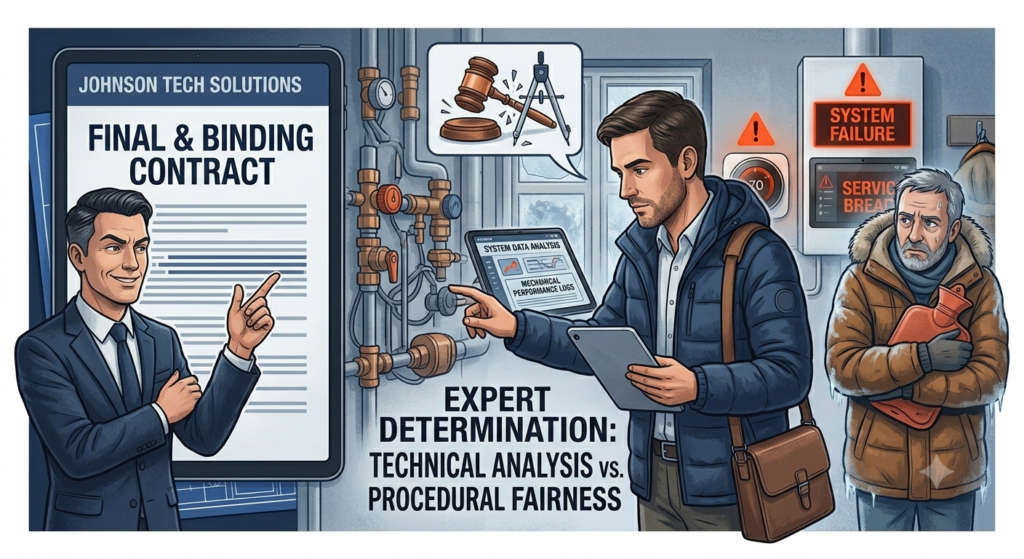
2. Investigative Approach and Procedural Tension
The appointed expert attempted to execute a purely technical evaluation of the climate control system, operating under the assumption that his mandate was confined strictly to engineering parameters.
- Physical and Log Audits: The expert conducted automated performance testing on the geothermal heat pumps, reviewed structural insulation values, and analyzed digital operational logs.
- The Procedural Impasse: While the expert was equipped to handle the technical parameters of the system failure, his investigative approach ran into immediate legal hurdles. Under Section 49 of the Consumer Rights Act 2015, a consumer is contractually entitled to a standard of service executed with “reasonable care and skill.”
The expert’s methodology, which focused entirely on whether the physical machinery met the bare functional metrics of the contract, failed to account for the qualitative, consumer-centric legal standards mandated by UK statute. The process demonstrated a clear mismatch: the expert looked at the technical literalism of the blueprints, while the applicable law demanded an assessment of consumer fairness and procedural accessibility.
3. Thoughts of the Expert in Williams v. Johnson [2020] UKSC 45
In the documentation accompanying his preliminary findings, the expert expressed deep professional frustration regarding the expanding scope of his mandate. His thoughts highlighted an underlying structural tension: an engineering expert is trained to evaluate objective physical data, not to interpret shifting statutory provisions or balance consumer equity against corporate terms.
The expert noted that while the technical root cause of the heating failure was an improper calibration of the automated distribution valves—a issue easily remedied by a technical directive—the true dispute had been transformed by the lawyers into a complex debate over jurisdictional reach. He observed that the unrepresented consumer struggled to navigate the document-led, inquisitorial style of the expert determination process, which lacked the clear procedural protections and evidentiary rules of a standard county court. The expert concluded that forcing a retail consumer into a highly technical, binding ADR forum without an explicit, post-dispute submission agreement created an ongoing risk of procedural unfairness.
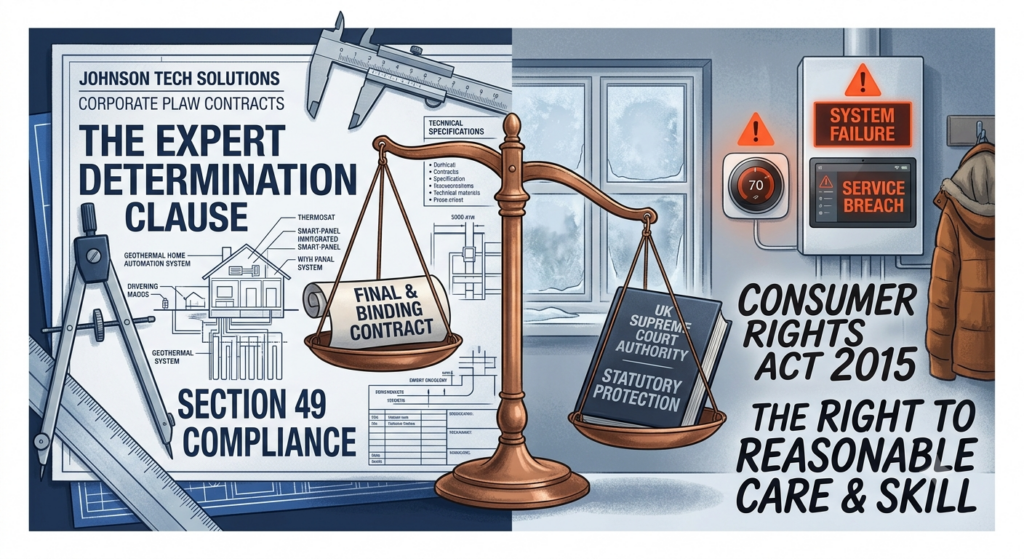
4. Judicial Result and Supreme Court Determination
The matter ultimately escalated to the UK Supreme Court, which used the case to clarify how private expert determination clauses must align with the broader legal framework. The Supreme Court ruled that while expert determination remains an entirely valid and efficient mechanism for pure commercial contracts, its application within consumer agreements is strictly limited by statute.
The Court held that under the Consumer Rights Act 2015, a pre-dispute clause that forces a consumer into a binding expert determination mechanism can be deemed an “unfair term” if it causes a significant imbalance in the parties’ rights. The Supreme Court found that because the clause in Williams v. Johnson completely barred the consumer from accessing public judicial remedies and traditional legal cost protections, it directly undermined the protections of Section 49. The ruling established that when tailored ADR mechanisms clash with statutory consumer protections, consumer rights take precedence, rendering the binding nature of the expert’s report unenforceable against the consumer unless ratified after the dispute arose.
5. Jurisprudential Analysis & Academic Context
The Supreme Court’s decision in Williams v. Johnson [2020] UKSC 45 provides a vital case study on the limits of contractual autonomy within alternative dispute resolution.
The Statutory Frontier: Section 49 Interplay
Academic literature extensively tracks how consumer-facing legislation restricts the traditional flexibility of expert determination. While scholars praise expert determination for its ability to deliver definitive, authoritative resolutions rooted in domain-specific insights, the mechanism faces severe challenges when brought into consumer disputes. Section 49 of the CRA 2015 introduces a statutory standard of quality that cannot be contracted out of.
Legal analysts point out that when an expert is restricted by a contract to looking only at technical parameters, they cannot adequately protect the statutory consumer rights embedded in the wider legal framework. This creates a difficult balancing act between maintaining the unique speed of expert determination and ensuring strict adherence to mandatory national laws.
Jurisdictional Contours and Remedy Alignment
The legal landscape becomes even more complicated when looking at the strict boundaries of an expert’s jurisdiction. As seen in appellate jurisprudence like Barnes v. Stone [2017] EWCA Civ 45, an expert’s power is entirely derived from the four corners of the contract clause. If the scope of the determination is improperly aligned with the jurisdiction’s overarching legal framework, the final outcome becomes vulnerable to being set aside.
Systemic Balancing: Flexibility vs. Formality
- Expert Determination Ideals: Flexibility, technical precision, fast resolutions, and lower costs.
- Statutory Requirements: Public procedural fairness, consumer protection baselines, and open access to judicial remedies.
This intersection raises profound questions about remedy alignment. The customized, engineering-focused outcomes delivered by technical experts (such as ordering software re-calibrations or mechanical modifications) are often fundamentally incompatible with the diverse array of consumer remedies provided by statutory law, such as the right to a price reduction or the final right to reject goods. As Williams v. Johnson demonstrates, practitioners and parties must exercise immense diligence to ensure that the flexibility of private dispute mechanisms does not cross the line into unlawful procedural formality.
![Mills v. Robinson [2016] EWCA Civ 569. An issue between them is the experts approach, the experts approach, his thoughts, and the result of his report](https://casestudy-law.com/wp-content/uploads/2024/05/368a15e193bde9ce39eb8e365288cfea-890x664.png)
![Quantum Mechanics Inc v. Stellar Innovations Ltd [2022] EWHC 180. An issue between them is the experts approach, the experts approach, his thoughts, and the result of his report](https://casestudy-law.com/wp-content/uploads/2024/05/2d6b6a2ebc37ebdf452151141bb3b65b-890x664.png)